
1. What Is MRVLB? Why Would a Stock Ticker Appear in Crypto Markets?
Many newcomers see “MRVLB” for the first time and immediately wonder: “Is this a coin or a stock?” It doesn’t look like native crypto assets such as BTC, ETH, or SOL, nor does it resemble meme coins like DOGE or SHIB. Instead, it reads more like a traditional U.S. stock ticker.
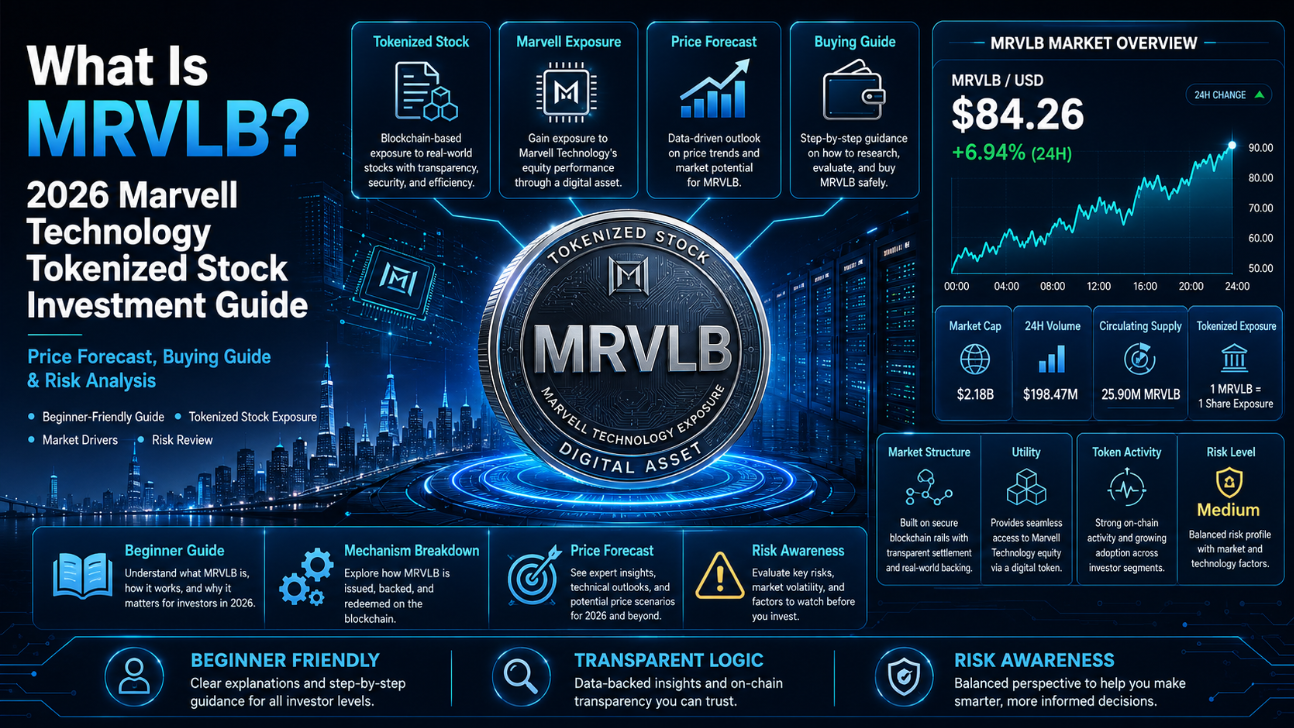
Simply put, MRVLB is Marvell Technology Tokenized bStocks – a real‑world asset (RWA) tokenized stock. It is not a standalone blockchain project or a conventional “project token.” Rather, it maps the value of Marvell Technology’s publicly traded stock into a crypto‑trading environment via token representation.
Users can check real‑time prices, trading data, and market movements for the MRVLB/USDT pair on Hibt’s MRVLB market page.
MRVLB’s core value logic does not hinge on “whether this blockchain project has ecosystem growth,” but on “whether the underlying Marvell Technology stock is valued by the market.” That is the fundamental difference between tokenized stocks and typical cryptocurrencies.
1.1 Basic Definition of MRVLB
MRVLB can be understood as an on‑chain representation of Marvell Technology stock‑related value. It belongs to the RWA asset class – that is, traditional assets like stocks, bonds, gold, funds, and real estate are digitized through blockchain technology.
The basic logic of asset tokenization is that an issuer or relevant institution represents real‑world assets as digital tokens on a blockchain, allowing users to trade or hold them in an on‑chain environment. Public information classifies MRVLB as a Marvell Technology bStocks Tokenized Stock – a tokenized stock tied to Marvell Technology.
Therefore, MRVLB is better viewed as “a trading instrument for stock exposure on‑chain,” rather than a crypto project that relies on community narratives, mining mechanisms, or dApp growth.
1.2 What’s the Difference Between MRVLB and Ordinary Stock MRVL?
The distinction between MRVLB and Marvell Technology’s common stock (MRVL) is one of the most confusing points for beginners.
- Ordinary stock MRVL is traded on U.S. equity markets. When you buy it, the trading environment, clearing system, regulatory framework, and shareholder rights all fall under traditional securities markets.
- MRVLB, in contrast, is a tokenized stock traded in crypto markets. It is typically priced in digital assets like USDT, and users see pairs such as MRVLB/USDT on exchanges. Its price tracks Marvell Technology’s stock performance, but the trading experience is closer to that of crypto assets.
A critical point: buying MRVLB does not make you a direct shareholder of Marvell Technology in the traditional sense. You hold tokenized stock‑related assets, not MRVL shares in a U.S. brokerage account. Whether you have voting rights, dividend entitlements, redemption mechanisms, or legal recourse depends entirely on the issuer, platform rules, and product terms.
For newcomers, think of it this way: MRVL is the stock in traditional securities markets, while MRVLB is the stock‑value mapping instrument in the crypto trading environment.
1.3 Why Is RWA Gaining So Much Attention in 2026?
In 2026, the crypto market’s focus on RWA has grown markedly. The reason is straightforward: in the past, many crypto assets derived value primarily from on‑chain narratives, liquidity, and market sentiment. RWA attempts to bring the value of already‑existing real‑world assets into blockchain markets.
Stocks, bonds, gold, funds, and other traditional financial assets are being tokenized and brought on‑chain. For crypto investors, this means they can gain exposure to traditional assets within the familiar USDT trading environment. For traditional finance, it also signals shifts in asset trading, settlement, and global circulation.
However, RWA is not a “sure‑win” sector. Recent research highlights that many RWA projects, despite the asset‑on‑chain concept, still face issues such as low liquidity, concentrated holdings, weak trading activity, and complex legal structures.
If you wish to explore similar assets, you can read Hibt’s content on other RWA offerings, such as What is AVGOB, What is AAOIB, and What is ARMB. Like MRVLB, these are new investment vehicles that bring stocks into the crypto space.
2. Who Is the Company Behind MRVLB? Why Does Marvell Technology Matter?
To understand MRVLB, you cannot look at the token alone – you must examine the underlying asset: Marvell Technology.
Marvell Technology is a semiconductor company focused on data infrastructure, data centers, networking, storage, custom silicon, and AI infrastructure. According to Marvell’s official materials, the company provides foundational technologies for compute, connectivity, and storage, with a portfolio increasingly serving AI‑driven data center demands.
This means the investment thesis for MRVLB is fundamentally different from that of typical crypto assets. Buying MRVLB gives you on‑chain exposure to Marvell Technology’s stock performance.
2.1 What Are Marvell Technology’s Core Businesses?
Marvell’s core business can be summarized as “semiconductor solutions for data infrastructure.” It is not a consumer‑facing chip brand; instead, it serves data centers, cloud computing, networking infrastructure, enterprise storage, and AI computing needs.
In the AI era, compute power is not just about GPUs. A large‑scale AI data center requires GPUs, CPUs, network switches, optical interconnects, storage chips, custom ASICs, data transmission, and high‑speed connectivity – all working together. Marvell’s importance lies in its critical position within the AI data center infrastructure chain.
In its fiscal year results released in March 2026, Marvell reported net revenue of $8.195 billion, a company record. Such financial data highlight that when analyzing MRVLB, investors should not just watch the price chart but also track Marvell’s revenue, profit margins, data center growth, and AI customer demand.
2.2 Why Are Semiconductor Stocks Market Hotspots in the AI Era?
The AI value chain is not a single point but an entire infrastructure stack.
At the top are large language models and applications; in the middle are cloud platforms and data centers; at the bottom are chips, networking, storage, and power infrastructure. GPUs handle training and inference, high‑speed interconnects manage data transfer, data centers solve deployment scale, and the semiconductor supply chain underpins long‑term AI expansion.
Marvell’s market attention stems directly from this AI infrastructure demand. Reuters has reported that Marvell expects its custom silicon business to exceed $10 billion in revenue by fiscal 2029, driven by rising AI adoption and cloud companies’ investment in custom chips.
Thus, the upside case for MRVLB is not “a sudden on‑chain ecosystem explosion” but rather “whether the market continues to favor Marvell’s position in AI data centers and semiconductor infrastructure.”
2.3 How Does MRVLB Differ from Other AI‑Related Stock Assets?
From a thematic perspective, MRVLB, AVGOB, AAOIB, and ARMB can all be grouped under “AI + RWA + tokenized stocks,” but their underlying assets differ.
- MRVLB corresponds to Marvell Technology, with a stronger emphasis on data infrastructure, networking, custom silicon, and AI data center demand.
- AVGOB corresponds to Broadcom‑related assets, with an investment thesis leaning toward AI chips, networking chips, and demand from large tech customers. For more, read What is AVGOB.
- AAOIB is more of a general AI‑stock thematic token, suitable for those interested in the AI theme but not yet focused on individual names. See What is AAOIB.
- ARMB tracks ARM‑related tokenized assets, with key drivers around chip architecture, mobile ecosystems, edge computing, and AI endpoint devices. Continue with What is ARMB.
In short, MRVLB is not a pure “AI concept coin” – it is closer to “on‑chain exposure to an AI semiconductor stock.”
3. How Does MRVLB Work? What Exactly Is a Tokenized Stock?
The most common question from beginners: “How can a token represent stock value?”
This comes down to the basic structure of tokenized stocks.
Typically, tokenized stocks go through several steps: first, the actual stock or related financial asset exists in the traditional financial system; then a custodian, issuer, or service provider arranges the asset; next, it is issued as a token on a blockchain; finally, users can trade and hold it on supported platforms.
A simple path to understand:
Real stock assets → custody/issuance structure → tokenized on‑chain → exchange pairs like MRVLB/USDT → users buy/sell via crypto accounts
However, a blockchain token does not automatically equate to traditional legal stock ownership. The challenge of RWA lies exactly here: on‑chain tokens are a technical expression, while the underlying asset, custody relationships, legal rights, and redemption mechanisms still depend on off‑chain institutions and platform rules. Researchers note that many current RWA systems are “hybrid architectures”: on‑chain for representation and transfer, but core legal assurances remain off‑chain via law, custody, and compliance processes.
3.1 Basic Workflow of Tokenized Stocks
MRVLB’s operating logic can be broken down into five steps:
- Underlying asset – Marvell Technology stock or related securities value. Users should track Marvell’s stock performance, not a new blockchain’s roadmap.
- Custody/issuance/mapping mechanism – The token’s credibility depends on whether the issuer has clear asset backing, compliance arrangements, and transparent rules.
- Token issuance – The token (MRVLB) is issued on a blockchain as a tradeable asset.
- Trading platform – The exchange offers an MRVLB/USDT market, allowing users to buy/sell with USDT.
- Holding and P&L – Returns depend on MRVLB’s market price, which is influenced by Marvell’s stock price, crypto liquidity, and RWA sentiment.
3.2 Why Does MRVLB’s Price Change?
MRVLB’s price moves are typically driven by three factors:
- Marvell Technology’s stock price – In theory, if MRVL rises, MRVLB may benefit; if MRVL falls, MRVLB may face pressure. But they are not always perfectly synchronized due to exchange liquidity, premiums/discounts, order book depth, and market sentiment.
- U.S. equity market environment – Interest rates, tech valuations, AI investment cycles, semiconductor demand, earnings reports, and macroeconomics all affect Marvell’s stock. If the broader tech sector is under pressure, MRVLB can drop even if RWA sentiment is high.
- Crypto market liquidity – Since MRVLB trades in crypto markets, USDT availability, RWA sector热度, pair depth, and platform user activity affect short‑term prices. Shallow liquidity can cause more volatility than the underlying stock.
Therefore, newcomers should not treat MRVLB like a meme coin for chasing breakouts, nor should they rely solely on candlestick charts. A more rational approach is to simultaneously track MRVL’s price, the semiconductor sector, AI infrastructure demand, and MRVLB’s on‑chain or exchange trading data.
4. MRVLB Price Predictions: Where Does Future Upside Come From?
Many users search for “MRVLB price prediction” – what they really want to know is: will MRVLB go up? Does it have long‑term investment value from 2026 to 2030?
First, a disclaimer: no price prediction is a certainty. MRVLB’s forecast cannot be reduced to “price target X next year.” Instead, it should be built on three layers of analysis.
Users can check the prediction information on Hibt’s MRVLB Price Prediction page and combine it with their own judgment.
4.1 What Indicators Should Guide MRVLB Price Predictions?
- Fundamental value – Marvell Technology’s stock performance. Since MRVLB derives from Marvell, key references include revenue, profit margins, data center growth, AI customer orders, and custom chip outlook.
- Industry value – Whether the AI semiconductor sector continues to expand. If AI training, inference, cloud computing, and data center investment keep growing, Marvell and MRVLB may benefit. Conversely, if the AI investment cycle slows, semiconductor valuations may compress, pressuring MRVLB.
- Market value – The development of the RWA sector. If more traditional stocks, bonds, and funds move on‑chain, investor acceptance of tokenized stocks may rise, potentially boosting liquidity and attention for MRVLB.
4.2 Potential Upside Drivers for MRVLB
- RWA market expansion – As more users embrace “trading U.S. stock exposure with USDT,” demand for tokenized stocks may increase, especially for those who cannot easily access U.S. brokerages.
- AI infrastructure investment growth – Marvell is positioned in AI data centers, networking, and custom silicon. If major cloud providers continue heavy AI infrastructure spending, Marvell’s fundamentals could be re‑rated.
- Traditional asset on‑chain trend – If stocks, ETFs, government bonds, and funds increasingly enter blockchain rails, RWA could shift from a niche narrative to a major crypto sector, bringing more attention to MRVLB.
4.3 What Headwinds Could MRVLB Face?
Risks are equally clear:
- Disappointing Marvell earnings or slowing data center growth could directly hurt MRVLB.
- A cooling AI investment cycle or sector rotation could drag semiconductor stocks and MRVLB down (recent volatility in semiconductor names due to profit‑taking and rotation has already affected Marvell).
- Changes in RWA regulations could impact the trading, issuance, custody, and access rules for tokenized stocks.
- Shallow MRVLB/USDT liquidity could lead to slippage, execution difficulties, or price deviations from the underlying stock for larger trades.
Thus, MRVLB has a long‑term narrative, but it is not immune to short‑term volatility and structural risks.
5. What’s the Relationship Between MRVLB and ETH?
A frequent question: “Does buying MRVLB also depend on ETH? Will ETH’s rise push MRVLB up?”
The answer: ETH may affect market sentiment, but MRVLB’s core value still comes from Marvell Technology’s stock performance.
- ETH is a native blockchain asset, representing the Ethereum network ecosystem, DeFi activity, Layer‑2 development, on‑chain applications, and gas demand.
- MRVLB is an RWA asset, representing on‑chain exposure to Marvell’s stock value.
Both trade in crypto markets, but their value sources are not the same.
For context, you can check Hibt’s ETH Price Prediction to understand ETH’s logic as a major public‑chain asset, and then contrast it with RWA assets like MRVLB.
5.1 Does ETH Rising Drive MRVLB Higher?
When ETH rises, it often signals increased risk appetite in crypto markets, more active DeFi funds, and stronger on‑chain trading sentiment. In that environment, the RWA sector may attract more attention, and MRVLB’s trading activity could pick up.
However, this does not mean ETH up = MRVLB up.
Because MRVLB’s primary value anchor is Marvell’s stock, not the Ethereum network. If ETH rises but Marvell’s stock falls, MRVLB will likely still decline. Conversely, if ETH is flat but Marvell delivers strong earnings and the semiconductor sector rallies, MRVLB could gain.
5.2 Core Differences in Investment Logic: MRVLB vs. ETH
- MRVLB is closer to stock investing – you need to analyze company fundamentals, industry cycles, earnings, valuations, and U.S. equity market sentiment.
- ETH is closer to public‑chain investing – you focus on Ethereum’s ecosystem, Layer‑2 scaling, on‑chain apps, staking, gas revenue, developer activity, and broader crypto cycles.
- MRVLB risks – company‑specific, stock market, token issuance, and liquidity.
- ETH risks – public‑chain competition, technology roadmap, regulatory policies, and crypto market cycles.
So, MRVLB and ETH can coexist in the same crypto portfolio, but they should not be analyzed as the same asset class.
6. How to Buy MRVLB: A Step‑by‑Step Guide for Beginners
For newcomers, buying MRVLB is not overly complex – but before placing an order, you must understand that it is not a typical cryptocurrency; it is a tokenized stock.
6.1 What Do You Need to Prepare?
- Choose a trading platform that supports MRVLB/USDT. Start by visiting Hibt’s MRVLB market page to check real‑time prices, order books, and market updates.
- Complete platform registration and security settings – enable two‑factor authentication, set a fund password, and confirm that your region allows trading such products.
- Acquire USDT – MRVLB is usually priced in USDT, so you need to deposit or purchase USDT first.
- Search for MRVLB or MRVLB/USDT in the trading section and enter the trading page.
- Choose between limit orders and market orders based on your strategy. Beginners are advised to start with a small test amount to check execution price, fees, and slippage before scaling up.
- After the trade, regularly monitor MRVLB’s price, Marvell’s stock, the AI semiconductor sector, and RWA market sentiment.
6.2 Is MRVLB Suitable for Buying or Long‑Term Holding?
MRVLB is suitable for three types of users:
- Those bullish on the long‑term AI semiconductor trend – if you believe AI data centers, cloud computing, custom silicon, and high‑speed connectivity demand will continue growing, MRVLB offers an on‑chain way to gain Marvell exposure.
- Those who believe in RWA development – if you think stocks, bonds, funds, and more assets will increasingly move on‑chain, MRVLB represents an early form of RWA stock assets.
- Crypto users seeking on‑chain exposure to U.S. equities – tokenized stocks provide an alternative path compared to opening a traditional brokerage account.
However, MRVLB is not suitable for those chasing short‑term explosive gains, nor for those who are completely unfamiliar with stock fundamentals, earnings cycles, and U.S. market volatility. If you are used to meme coins, “degen” tokens, or high‑leverage contracts, MRVLB’s investment logic may be entirely different from what you are accustomed to.
7. Risk Analysis for MRVLB: 5 Things You Must Know Before Buying
A proper investment guide must cover not only opportunities but also risks – especially for RWA and tokenized stocks, which sit at the intersection of traditional finance and crypto, with more complex risk structures than plain spot tokens.
Risk 1: MRVLB Is Not Traditional Stock
Buying MRVLB is not the same as buying Marvell Technology common stock. You may not have voting rights, corporate governance rights, or direct shareholder entitlements.
If you treat MRVLB as a perfect substitute for MRVL, you will misjudge risks. Always review the platform’s and issuer’s disclosures on asset rights, redemption, custody, and trading rules.
Risk 2: Issuer and Custodial Risk
Tokenized stocks usually depend on issuers, custodians, exchanges, and compliance structures. If custody arrangements change, the issuer faces issues, or the platform discontinues services, the liquidity and enforceability of your holdings could be affected.
The core difficulty of RWA is not just “can it be tokenized” – but whether the off‑chain asset is genuine, custody is transparent, legal relationships are clear, and redemption mechanisms are reliable.
Risk 3: Liquidity Risk
MRVLB is not BTC or ETH. Its trading volume and market depth may be lower than mainstream crypto assets.
If market participants are few, you may encounter wide slippage, thin order books, or slow execution when buying or selling MRVLB. For larger amounts, liquidity risk is especially critical.
Risk 4: U.S. Equity Market Risk
Because MRVLB tracks Marvell Technology, it cannot escape U.S. stock market risks.
If Marvell’s earnings disappoint, or the AI semiconductor sector pulls back, MRVLB’s price may drop. Changes in U.S. interest rates, tech valuation compression, or falling risk appetite can also affect it.
These risks cannot be solved by watching crypto sentiment alone – investors must monitor U.S. markets and company fundamentals.
Risk 5: Regulatory Risk
Tokenized stocks operate in a still‑evolving regulatory space. Different jurisdictions have varying rules on tokenized securities, RWA, and stock‑mapping assets.
If future rules tighten, MRVLB’s trading, issuance, circulation, or user access could be impacted. For long‑term holders, regulatory risk must be factored in advance.
8. MRVLB, AVGOB, AAOIB, ARMB: How Should RWA Investors Choose?
If you are building an RWA tokenized‑stock portfolio, you should not look only at MRVLB – compare the industry logic of different underlying assets.
- MRVLB (Marvell Technology) – semiconductors, data infrastructure, AI data center connectivity, custom silicon. Best for those bullish on AI infrastructure and Marvell specifically.
- AVGOB (Broadcom‑related) – AI chips, networking chips, software, and large‑tech customer demand. To compare Marvell and Broadcom, read What is AVGOB.
- AAOIB – more general AI stock theme, combining AI industry trends with on‑chain stock assets. Good for those interested in AI but not betting on a single chip company. Continue with What is AAOIB.
- ARMB (ARM‑related) – chip architecture, mobile ecosystem, AI endpoints, edge computing. If you follow chip design rather than data center connectivity, see What is ARMB.
Additionally, if you want to expand from RWA assets to Web3 project‑type assets, you can also read What is PONS to compare the value logic of “project tokens” vs. “tokenized stocks.”
In short: MRVLB leans on Marvell’s fundamentals, AVGOB on Broadcom’s growth, AAOIB on the AI thematic, and ARMB on chip architecture ecosystems. Your choice should not be based on short‑term price movements, but on which underlying asset you truly believe in.
9. Future Development of MRVLB: Will RWA Become the Next Crypto Hotspot?
MRVLB’s long‑term value is closely tied to the growth of the RWA market.
In the coming years, three important trends may emerge in RWA:
- Traditional financial assets moving on‑chain – stocks, bonds, funds, gold, private credit – all could be tokenized and brought to blockchains. For users, this means crypto accounts may hold not only native tokens but also a broader range of traditional assets.
- Globalized trading hours – traditional stock markets have limited trading sessions, while crypto markets run nearly 24/7. If tokenized stock markets continue developing, users may gain more flexible trading experiences.
- Fusion of stocks and crypto – in the future, users might hold BTC, ETH, stablecoins, RWA tokens, and tokenized stocks all in one account. Such asset mixes could change how some investors allocate capital.
But it must be emphasised: RWA growth does not guarantee that every RWA token will rise.
An RWA token’s value still depends on asset quality, issuance mechanisms, custody transparency, trading liquidity, compliance, and market demand. MRVLB is no exception. It benefits from Marvell’s stock value, but it also faces its own liquidity and regulatory hurdles.
10. Conclusion: What Type of Investor Is MRVLB For?
MRVLB is not an ordinary cryptocurrency, nor is it a pure AI concept coin. It is more like a new investment vehicle that brings Marvell Technology stock value into the blockchain world.
If you are bullish on the AI semiconductor industry, believe in Marvell’s position in data centers, networking, custom silicon, and AI infrastructure, and also see value in the RWA on‑chain trend, then MRVLB deserves a spot on your watchlist.
If you want exposure to U.S. equity‑like assets through a USDT‑trading environment, you can track price changes via Hibt’s MRVLB market page and use the MRVLB Price Prediction page as an additional reference.
However, if you are only hunting for short‑term explosive assets, or if you do not understand stock fundamentals, earnings cycles, custody mechanisms, and RWA regulatory risks, then MRVLB is not suitable for heavy positions.
One‑sentence summary: MRVLB is not about “will this new crypto project explode?” – it’s about “whether Marvell Technology’s stock value can gain broader acceptance among crypto market participants via RWA.”
For investors in 2026, MRVLB is worth following – but it is better approached with a research‑oriented, allocation‑based, and risk‑controlled mindset, rather than with the same tactics used to chase meme coins.